
The dissertation: Train from Within: An Embodied Approach to Intense Exercise

I'm thrilled to share my full dissertation for obtaining my MSc in Positive PSychology and Coaching Psychology from the University of East London. While this is the final output, what you do not see is the 2.5 years of intense studies, research, writing, application, and coaching that lead to this point. I'm proud to say I graduated with distinction, while this is one of the hardest academic challenges I've faced in my life, it was worth every second!
For the Appendix or reference list articles, please contact CoachSunnee@gmail.com. Enjoy!
For decades, researchers have explored embodiment—the lived experience of engaging with the world through the body (Piran, 2017). Embodiment is multifaceted, including interoception, body awareness, and body ownership, which together shape critical aspects of self, such as emotional regulation, self-concept, and well-being (Herbert & Pollatos, 2012; Maister et al., 2017). Conversely, disembodiment—detachment from one’s body, whether through low interoception, trauma, or social experiences—can lead to emotional dysfunction (Treves et al., 2019) and negative psychological and physiological outcomes, such as eating disorders and somatoform disorders (Farb et al., 2015; Leech et al., 2024).
The developmental theory of embodiment (DTE; Piran, 2017) conceptualizes embodiment as a dynamic, multidimensional process shaped by how we inhabit our bodies through social experiences. The theory outlines five dimensions, “body connection and comfort, agency and functionality, experience and expression of desire, attuned self-care, and inhabiting the body as a subjective site and resisting objectification” (Piran, 2017, p. 4), and three social domains: physical, mental, and social power and relational connections. Experiences across these dimensions and domains exist on a spectrum from positive to negative embodiment. For example, attuned self-care may present positively when one chooses to exercise because it supports their emotional well-being and they respond flexibly to cues for rest or recovery; conversely, it may result in negative outcomes when exercise is used as punishment or when bodily cues are ignored in pursuit of aesthetic or performance ideals.
Research links positive embodiment to enhanced well-being, such as positive body image (Menzel & Levine, 2011), satisfaction with life (Gattario et al., 2020), and self-esteem (Piran et al., 2023b). Given its profound influence on health outcomes, understanding what facilitates embodiment and how to foster it is essential. It is the core mission of this dissertation.
Researchers have explored the role of various movement-based interventions in cultivating embodiment, often focusing on mindfulness-based practices such as yoga, tai chi, and qigong (Menzel & Levine, 2011; Mulder et al., 2025), which naturally enhance embodiment through deliberate movement, interoceptive awareness, and mind-body integration (Schneider et al., 2019). Research disproportionately focuses on lower-intensity, mindfulness-based activities, with far less evidence exploring if more vigorous forms of exercise—such as power lifting or high-intensity interval training—could influence embodiment (Wallman-Jones et al., 2021). This distinction is especially important given that many traditional forms of intense exercise prioritize performance, aesthetics, and external metrics over internal connection, contributing to a culture of disembodied movement at intensity (Porcari & Foster, 2010; SantaBarbara et al., 2017). In exercise settings, distraction or disconnection can lead to dysfunctional behaviors such as ignoring pain signals (Calogero et al., 2019), under- or overexertion (Wallman-Jones et al., 2021), and negative rebound effects from suppressed internal cues (Farb et al., 2015).
As a certified personal trainer and health coach with over 20 years of experience, I have firsthand knowledge of education and training standards for health and fitness professionals in the United States. The American Council on Exercise (ACE), a leading certifying organization, notes within its certified personal trainer curriculum that: “Mind-body exercises are often performed for reasons other than cardiorespiratory training… as such, mind-body exercise is generally not associated with high-intensity aerobic activity. Pilates, Hatha yoga, and tai chi are representative of mind-body exercise” (La Forge, 2014, p. 416). Despite emerging evidence, organizations like ACE continue to exclude intense exercise (IE) from embodiment discourse, reinforcing research and application gaps within their certification standards. Furthermore, the structure of ACE’s training program positions embodiment and IE as mutually exclusive domains. My goal is to challenge this perspective.
The absence of embodiment-focused interventions in IE settings represents both a research gap and a missed opportunity. Exercise-science research grounded in the dual-mode theory of affective responses to exercise (Ekkekakis, 2009) suggests that individuals naturally shift inward at higher intensities to regulate effort using internal physiological cues, presenting a promising entry point for cultivating internal connection and embodiment. This dissertation addresses that opportunity by developing a coaching intervention for health and fitness professionals, equipping them with strategies to foster positive embodiment through IE among their clients and communities. The intervention reframes IE as a space for internal connection and self-awareness alongside performance, questioning the exclusivity of embodiment-based movement within low-intensity, yoga-based practices.
To expand embodiment discourse beyond low-intensity practices, this dissertation comprises two primary components: (a) a systematic literature review (SLR) identifying empirical factors that facilitate embodiment in healthy adults, and (b) the design of a theoretically grounded, evidence-based coaching intervention to increase embodiment through IE.
A Systematic Review of the Factors Facilitating Embodiment in Adults
Review Aims
While embodiment has been widely explored across various disciplines, a consolidated synthesis remains limited. This SLR addresses this gap by integrating multidisciplinary findings to offer the first comprehensive framework that informs future research and intervention strategies aimed at enhancing positive embodiment.
Materials and Methods
This SLR follows condensed PRISMA guidelines (Page et al., 2020) and a pre-approved research protocol (Appendix A). Methodological approaches from prior embodiment SLRs were analyzed and database searches were designed in consultation with a university librarian. Appendix B presents the final search string and justifications for modifications.
Search Strategy and Eligibility Criteria
Studies were included if they: (a) investigated factors of embodiment in healthy adults, (b) used validated embodiment measures, (c) reported empirical findings, (d) included pre- and post-test data, and (e) were published in English within the past 10 years. The search strategy incorporated embodiment-related terms (e.g., "body awareness," "embod*”) and disciplinary keywords (e.g., "physical," “psychophysiolog*,” “neurolog*"). Searches were conducted in PsychINFO and PubMed (December 6, 2024) and in Scopus (December 14, 2024). Further details are available in Appendix A.
Study Selection
The search yielded 620 studies, which were imported into EPPI Reviewer, a systematic review management tool. After removing nine duplicates, 611 studies underwent title and abstract screening, leading to the exclusion of 577 studies. A full-text review of the remaining 34 studies resulted in 12 meeting inclusion criteria (Figure 1).
Data Extraction
Data were manually extracted into Google Sheets, including publication year, geographic location, study design, sample size, demographics, embodiment outcome measures, determinants, and significant findings (Appendix C provides full study details).
Data Analysis & Synthesis
A narrative review approach analyzed key findings, which are summarized in Table 1. Due to substantial heterogeneity in study aims, embodiment dimensions, and methodologies, studies were first grouped by intervention type: movement (n = 4), illusory interventions (n = 4), and neural activation (n = 2). Two studies were uncategorized and analyzed independently. Thematic synthesis was then applied to identify recurring patterns and concepts across studies. The demographic profile consisted predominantly of young adults (19–38 years old), 72.02% female, with a normal BMI (≤23.2).
Strength of Evidence & Quality Assessment
The selected studies were assessed using modified Critical Appraisal Skills Programme checklists (CASP; 2024). Eleven studies were deemed methodologically sound, while one study (Carey et al., 2019) had some methodological concerns. Higher-quality studies were weighted more heavily (Appendix D provides full assessments).
Figure 1.
PRISMA flowchart

Table 1.
Summary of Included Studies.
Study | Study Applicability | Key findings | Key Implications | Embodiment Dimension | Intervention |
Physical activity and exercise | |||||
Alleva et al., 2020 | - Effects of yoga on embodiment and PBI facets. - Roles of embodiment, self-objectification, functionality appreciation in improving PBI. | - Hatha yoga significantly increased embodiment. - Embodiment predicted body appreciation, body compassion, and appearance evaluation. - Greater embodiment and lower self-objectification predicted improvements in PBI. | Embodiment and self-objectification play key mediating roles in PBI and its correlates; Hatha yoga is a potential intervention to facilitate these changes. | Embodiment during PA | Movement |
Günebakan & Acar, 2023 | Effect of tele-yoga on body awareness and other measures during COVID-19. | - Body awareness non-significantly increased in the tele-yoga group and decreased in the control group. | Hatha yoga can enhance body awareness (Garnsey et al., 2025); the non-significant increase highlights contextual role in influencing body awareness. | Body Awareness | Movement |
Jankauskiene et al., 2024 | Effects of Nirvana fitness (NF) and functional training (FT) on body appreciation, MBC, and other measures. | - MBC improved significantly in the FT group and non-significantly in the NF group. - MBC mediated improvements in body appreciation and surveillance (significant in FT group, non-significant in NF). - FT group showed significant improvements in all variables | Results introduce the positive impact of moderate- to-vigorous exercise on MBC, body appreciation, and correlates. | Embodiment during PA | Movement |
Interoception | |||||
Moffatt et al., 2024 | Effects of cardiac timing on IAcc and body ownership via the rubber hand illusion. | - Synchronous touch increased embodiment and shifted perceived hand location. - Little evidence for the influence of IAcc or cardiac timing effects on subjective embodiment or proprioceptive drift. | - Cardiac timing plays little, if any, role in subjective embodiment. - Those with lower IAcc were more susceptible to illusions. | IAcc
Body Ownership
Embodiment | Illusory |
Monti et al., 2020 | Influence of breath and visual congruency on interoception. | - Respiratory congruence increased body ownership and agency. - Body ownership was enhanced by congruence in visual appearance and spatial perspective. - Individuals with lower IAcc and ISen were more susceptible to intervention manipulations. | Breath is a key interoceptive signal; focusing on it can enhance embodiment and interoception. | Interoceptive Awareness
IAcc | Illusory |
Salvato et al, 2020 | Identify neural networks underlying bodily self-awareness (objective body ownership and interoception). | - Separate analyses revealed unique and overlapping brain regions activated during body ownership and interoception. | Body ownership and interoception converge in shared brain regions highlighting the objective and subjective nature of bodily self-awareness. | Body Ownership
Interoception | Neural |
Wallman-Jones et al., 2023 | Influence of everyday behaviors (exercise, PA, screen time, sedentary time, social interactions, sleep) and baseline IAcc on interoception. | - Positive relationship between PA and interoception, with exercise showing stronger effects than PA. - Screen time and sedentary behavior decreased interoception - Non-screen time behaviors increased interoception, regardless of social or solitary contexts. | - Interoception is dynamic and contextual, strongly influenced by activity and attentional context. - Bidirectional positive relationship between exercise and interoception. | Interoceptive Awareness
IAcc | Movement & observational |
Context. | |||||
Carey et al., 2019 | Impact of perceptual congruence and subthreshold eating disorder (ED) psychopathology on subjective embodiment. | - Visual capture significantly induced subjective embodiment. - Tactile disruption significantly lowered subjective embodiment. - No significant correlation found between subthreshold ED psychopathology and embodiment. | Perceptual congruence and visual observation induce subjective embodiment. | Subjective embodiment | Illusory |
Maister et al., 2017 | Influence of romantic relationships and attachment quality on IAcc. | - Lower IAcc group: significant IAcc differences were observed for both self-face and partner-face images, with significantly higher improvements in partner-face. - Higher IAcc group: No significant differences in IAcc were observed. | The relational-self and romantic partners play key roles in interoceptive awareness and one’s sense of self. | Interoception via IAcc | Uncategorized |
Treves et al., 2019 | Relationship between objective body awareness and short-term, long-term, and trait mindfulness. | - Mindfulness showed a small, statistically significant positive effect on objective body awareness. - Mindfulness effects were insignificant for heartbeat tasks. - Only short-term mindfulness studies showed a significant relationship. | IAcc improvements are task-specific: the small effect size reflects mindfulness’s focus on subjective, not objective, body awareness. | Objective Body Awareness
Interoception | Uncategorized |
Wittkopf et al., 2017 | Influence of mirror-reflected hand size and congruency on subjective embodiment. | - Across all conditions, individuals experienced enhanced embodiment of the reflection; normal-sized reflection showed significant findings. | - Highlights importance of visual congruence in subjective embodiment.
| Subjective Embodiment
Body Ownership | Illusory |
Wang et al., 2016 | Explore the neural basis of embodied perspective-taking | - Results highlight the embodied nature of social perspective-taking and show how physical context supports cognitive performance. | Task and postural context influence embodied self-awareness: embodiment is shaped by situational demands. | EPT | Neural |
Notes. Physical activity (PA); positive body image (PBI); mind-body connection (MBC); interoceptive accuracy (IAcc); interoceptive sensibility (ISen).
Results & Discussion
Thematic synthesis by intervention type revealed three key facilitators of embodiment: physical activity and exercise, interoception, and contextual influences. The full results summary is provided in Appendix C.
Theme 1: Physical Activity and Exercise
Strong evidence supports the positive relationship between low-intensity physical activity and embodiment facets, while limited evidence suggests a similar effect for moderate- to vigorous-intensity exercise. Four studies examined the relationship between physical activity and embodiment, with most prioritizing low-intensity modalities including Hatha yoga (Alleva et al., 2020; Günebakan & Acar, 2023). One study explored the impact of daily behaviors—including physical activity—on interoception, discussed further in theme two (Wallman-Jones et al., 2023). Notably, Jankauskiene et al. (2024) compared functional training to yoga-based Nirvana Fitness and found that the more intense functional training significantly improved mind–body connection and reduced body surveillance, highlighting the potential for non-yoga, higher-intensity exercise to facilitate embodiment. Results align with DTE, which posits that embodiment is enhanced through bodily engagement and mindfulness-based activities (Piran & Neumark-Sztainer, 2020). Notably, the prevalence of yoga-based interventions highlights the field’s reliance on low-intensity activity, however, there is a need to explore embodiment in more intense, non-yoga contexts.
Yoga is widely recognized as an embodying activity because it integrates movement, mindfulness, and body awareness (Piran & Neumark-Sztainer, 2020; Mahlo & Tiggemann, 2016). However, yoga has also been associated with comparative critique, negative self-talk, feelings of inadequacy (Neumark-Sztainer et al., 2019), exclusivity, and “yoga body” ideals (Webb et al., 2017), suggesting that studio environments may inadvertently trigger or worsen negative body image, making yoga unappealing for some.
Findings comparing the effects of yoga versus non-yoga exercise on embodiment remain mixed. Daubenmier (2005) reported that yoga practitioners demonstrated greater body awareness, reduced self-objectification, and improved body satisfaction compared to aerobic exercisers, though the study examined mediation rather than causality. Mulder et al. (2025) found positive relationships between interoception, cognitive leisure activities (including yoga-based practices), and non-yoga exercise, though exercise intensity and format were unspecified. A meta-analysis (Schneider et al., 2019) of 40 studies reported varied results regarding mindfulness-integration and physical activity. While dispositional mindfulness correlated weakly to moderately with overall physical activity, yoga demonstrated a positive association, whereas aerobic exercise correlated negatively. The researchers suggest this may be because aerobic exercise is often performed with less internal focus. These findings highlight how both intensity and attentional focus may shape embodiment—an important consideration when integrating embodiment into more intense exercise settings.
The dual-mode theory posits that at higher exercise intensities, attentional focus shifts from cognitive to interoceptive cues, requiring individuals to regulate breathing, heart rate, and posture, potentially enhancing interoception (Ekkekakis, 2009; Wallman-Jones et al., 2021). Studies linking exercise to interoceptive self-reports further support this correlation (Wallman-Jones et al., 2023), suggesting that more intense exercise may facilitate embodiment and thus expand intervention possibilities beyond low-intensity movement.
Theme 2: Interoception
Four studies provide strong evidence of the importance of interoception on embodiment (Moffatt et al., 2024; Monti et al., 2020; Salvato et al., 2020; Wallman-Jones et al., 2023). Interoception—the process of sensing internal bodily states—is a core mechanism of embodiment (Herbert & Pollatos, 2012). It is typically divided into three dimensions: interoceptive awareness, the ability to perceive and interpret bodily sensations; interoceptive accuracy, the precise detection of bodily signals such as heartbeat; and interoceptive sensibility, the subjective experience of internal sensations (Pfeifer & Cawkwell, 2025).
Wallman-Jones et al. (2023) demonstrate that interoception is dynamically shaped by activity and attentional context. Self-reported interoception increased with physical activity (particularly exercise), non-screen time behavior, and social interactions while sedentary and screen-based behavior decreased it. Although primarily focused on interoception, the study also contributes to broader embodiment research by linking movement to interoceptive enhancement and showing how behavioral context shapes bodily awareness. Findings from illusory interventions (Moffatt et al., 2024; Monti et al., 2020) suggest that individuals with lower interoception are more susceptible to bodily illusions, whereas those with higher interoception retain a stronger sense of body ownership and self-awareness (Seth, 2013). This aligns with predictive coding framework, which proposes that stronger interoceptive signals stabilize embodiment by reducing prediction errors (Farb et al., 2015; Seth, 2013). Salvato et al. (2020) further support this view, showing that bodily self-awareness arises from the convergence of body ownership and interoceptive processing in shared brain regions. Collectively, these findings suggest that strengthening interoception may help individuals maintain a coherent sense of self during intense exercise and movement—with movement itself increasing interoception, even when external feedback is ambiguous or overwhelming.
Beyond embodiment, interoception is fundamental to psychological well-being (Farb et al., 2015). Disorders such as depersonalization and post-traumatic stress disorder are linked to low interoceptive abilities (Leech et al., 2024), while overly heightened interoception can contribute to anxiety or panic disorders (Mehling et al., 2012). Predictive coding framework offers a useful lens here, framing interoception as the mechanism through which the brain predicts and interprets bodily states (Seth, 2013). When these predictions are inaccurate—such as interpreting a racing heart as anxiety instead of exertion—emotional dysregulation may result. In the context of this dissertation, helping clients interpret intense bodily cues accurately is central to fostering both psychological resilience and positive embodiment through IE.
Theme 3: Context
While most studies did not explicitly quantify social context, deeper analysis revealed strong evidence that contextual factors influenced embodiment outcomes in six studies. Three studies demonstrated how embodiment can be modulated by perspective and neural activation (Wang et al., 2016), perceptual congruence (Carey et al., 2019), and multisensory illusions (Wittkopf et al., 2017)—highlighting the role of task and perceptual context. While their research offers valuable contributions to embodied cognition and the neuroscience of body representation, this dissertation focuses on embodiment as shaped through social and environmental experiences rather than simulated cognitive or perceptual manipulations.
In contrast, Günebakan et al. (2023), Maister et al. (2017), and Treves et al. (2019) emphasized socially grounded forms of context. Although mentioned above, Günebakan et al.’s (2023) tele-yoga intervention reported non-significant increases in body awareness, diverging from studies that found significant improvements (Garnsey et al., 2025). A key contextual factor was timing—the study took place during the COVID-19 lockdown. Given that stress negatively affects body awareness, high stress levels may have influenced outcomes (Mehling et al., 2012). Maister et al. (2017) found that individuals exhibited higher interoceptive accuracy when viewing images of romantic partners versus self-related or neutral images, suggesting social relationships influence interoception. This supports DTE, which emphasizes that empowering relationships enhance embodiment (Piran, 2017).
A meta-analysis (Treves et al., 2019) reported a small but significant effect of mindfulness training on interoceptive accuracy, though the effect varied based on mindfulness modality. Notably, this effect was dependent on the types of mindfulness examined—long and short-term meditators, as well as dispositional traits—which focus on subjective bodily experiences versus objective interoceptive accuracy. Thus, interoception might be context-dependent. That is, to increase interoceptive accuracy, tune into objective cues; to increase interoceptive sensibility, be subjective (Farb et al., 2015).
Taken together, these findings reinforce the notion that embodiment is context-dependent, shaped by social, environmental, and situational factors (Piran et al., 2023c).
Strengths and Limitations
The studies demonstrated methodological quality with a low risk of bias based on modified CASP quality assessments (Appendix D). Several limitations, however, must be acknowledged. The small sample of 12 studies, though rich in detail, exhibited considerable heterogeneity, complicating direct comparisons. Diverse embodiment measures and inconsistent, non-standardized terminology further limited comparability. Additionally, the absence of follow-up assessments restricts understanding of long-term embodiment impacts. And, while the thematic synthesis prioritized embodiment as shaped by social and environmental experiences, it is limited because it excludes neural and cognitive contributions.
Demographic constraints limit generalizability to broader populations. BMI considerations are critical. Higher BMI correlates with lower interoception (Robinson et al., 2025) and reduced body appreciation (Tylka & Wood-Barcalow, 2015). However, causality remains unclear; Piran et al. (2023b) suggest that a weightist culture undermines positive embodiment.
Age also matters, as generalizability to older populations exists. Research highlights known age-related declines in interoception, yet these declines are not linear, as older adults might rely more on cognitive interpretations than interoceptive sensations (Pfeifer & Cawkwell, 2025). This SLR revealed (young) age bias, and future embodiment research should expand to older populations.
Gender imbalance is also a pitfall, particularly female overrepresentation that reflects trends in embodiment research, given stronger societal pressures on women’s body image (Piran et al., 2017; Halliwell, 2013). Caution is warranted when projecting to men because gendered patterns exist. That is, women report more negative embodiment (Gattario et al., 2020) and higher interoceptive sensibility while men report higher interoceptive accuracy (Grabauskaitė et al., 2017).
DTE proposes an answer to many of these limitations. Rather than attributing embodiment solely to demographics, DTE looks to social experiences and one’s relationship with the body (Piran et al., 2023b). For instance, a woman with obesity practicing body appreciation may experience greater positive embodiment than a normal-weight man with poor body connection. This underscores the importance of subjective body experiences over objective demographics in embodiment research.
Systematic Review Process
The SLR process also has limitations. First, relevant studies may have been overlooked due to database and search term restrictions. Second, as a single-reviewer project, the SLR carries an inherent risk of bias or misinterpretation even though rigor and transparency were prioritized at every stage.
All methodological decisions and analyses were clearly documented, following guidelines noted above. CASP checklists and ongoing reflection on potential bias helped ensure that findings were grounded in the data rather than preconceived assumptions. While multiple research analysis approaches were available, the chosen method was selected based on the research question and the need to identify the most prevalent embodiment facilitators. And, due to the high level of heterogeneity, the SLR process required a strategic, interpretative synthesis that balanced comprehensive analysis with meaningful pattern recognition across studies.
Conclusions
To summarize: this review synthesized multidisciplinary evidence to elucidate key determinants facilitating embodiment among healthy adults. Analysis of 12 studies identified three influential factors: physical activity and exercise, interoception, and context. Findings aligned with established theories such as DTE (Piran, 2017), dual-mode theory (Ekkekakis, 2009), and predictive coding framework (Rao & Ballard, 1999), underscoring embodiment's complexity. Results highlight the pivotal role of exercise intensity and attentional focus in embodiment outcomes, as supported by dual-mode theory, which proposes a shift from cognitive to interoceptive cues with increased intensity (Ekkekakis, 2009). This suggests an untapped potential for IE to foster embodiment.
Future research should prioritize two key areas: the relationship between interoception and embodiment, and the potential of IE as a mechanism for enhancing both (Wallman-Jones et al., 2021). By addressing these areas, studies can bring embodiment into the conversation around IE. Such research positions embodiment as an essential component of physical movement, inclusively spanning low- to high-intensity exercise practices.
Embodied Intense Exercise: A Coaching Framework for Fitness Professionals
As highlighted previously, a well-documented connection exists between movement-based practices and embodiment. Despite emerging evidence supporting IE as a facilitator of embodiment, however, research remains limited (Mahlo & Tiggemann, 2016; Schneider et al., 2019). Additionally, many traditional forms of IE emphasize external performance metrics, aesthetics, and achievement over internal awareness, fostering a culture of disembodied movement (Porcari & Foster, 2010; SantaBarbara et al., 2017). The absence of embodiment-focused interventions for IE represents a missed opportunity. This artifact responds by exploring how IE—defined as a self-appraised rate of perceived exertion between 15 (‘hard/heavy’) and 20 (‘maximal exertion’) on the Borg scale (Borg, 1998)—can facilitate embodiment. Specifically, I will develop a coaching intervention for health and fitness professionals (HFPs), equipping them with strategies to foster positive embodiment in their communities through IE.
Artifact Proposal: An Evidence-Based Coaching Intervention
The intervention will integrate established theoretical frameworks and coaching strategies such as attentional awareness, agency development, affect regulation, and mindset shifts. Theories identified within the SLR—including DTE (Piran, 2017), dual-mode theory (Ekkekakis, 2009), and predictive coding framework (Rao & Ballard, 1999)—will bridge theoretical understanding with real-world applicability, ensuring intervention efficacy. Self-determination theory (SDT; Deci & Ryan, 2000) is also particularly useful in coaching contexts as it provides an empirically supported coaching framework for understanding how practices can support client autonomy, competence, and relatedness to naturally enhance motivation, goal achievement, and overall well-being (Spence & Oades, 2011). Given dual-mode theory’s assertion that IE is not inherently enjoyable, fostering intrinsic motivation through SDT’s psychological-needs framework is critical for initial engagement and long-term adherence (Ntoumanis et al., 2021); additionally, intrinsic goals positively contribute to daily moderate-to-vigorous physical activity (Standage & Ryan, 2020).
Equally important, DTE provides the intervention’s conceptual foundation, outlining embodiment’s multidimensional nature across social domains and dimensions (Piran, 2017). High intercorrelation among DTE’s domains suggests positive shifts within one dimension or domain can beneficially impact others (Piran et al., 2023a). Given the complexity of embodiment, a single intervention cannot address all domains and dimensions simultaneously; thus, this well-focused intervention prioritizes those most relevant to IE settings (Ciarrochi et al., 2022). Piran and colleagues emphasize the central role of the physical domain, underscoring the significance of joyful physical engagement, freedom of movement, and autonomy (Piran, 2017). This intervention prioritizes the physical domain and three specific DTE dimensions directly applicable to IE contexts: body connection and comfort, emphasizing a positive relationship with and experience of one’s body; agency and functionality, supporting personal control, self-expression, and enjoyment; and attuned self-care, promoting responsiveness to bodily, emotional, and relational cues. Empirical evidence supports the use of DTE for embodiment-based interventions (Piran et al., 2023c), with its dimensions serving as intervention targets (Piran et al., 2023b).
Additional theories further strengthen the intervention framework. Dual-mode theory (Ekkekakis, 2009) offers insights into how exercise intensity impacts attention and affect. Intentional change theory (Boyatzis, 2006) informs visualization and mental imagery techniques, enhancing intrinsic motivation and reshaping self-perception. Bandura’s (1997) self-efficacy theory complements SDT to support clients’ belief in their abilities, with contemporary evolutions highlighting visualization as a strategy to enhance efficacy beliefs (Maddux, 2002). Lastly, predictive coding framework (Rao & Ballard, 1999) informs the inclusion of progressive overload and diverse movement patterns, refining predictive bodily models to foster adaptability and embodiment (Wallman-Jones et al., 2021).
When thoughtfully guided and effectively applied, these theories suggest that IE can become a powerful avenue for cultivating positive embodiment. However, effectiveness hinges upon HFPs’ comprehension and implementation, as well as clients’ willingness to participate. To support both, the intervention prioritizes autonomy and accessibility to maximize intrinsic motivation.
I have personally witnessed the transformative power of embodied living. Integrating embodiment practices with IE has let me observe positive changes stemming from increased body attunement and embodied agency—listening, trusting, and responding to bodily signals aligned with personal needs (Piran, 2017). My goal is to extend this impact broadly by adopting a train-the-trainer approach to increase accessibility to positive embodiment practices in IE.
Planning
Planning the intervention will comprise three primary steps:
1. Define Intervention Quality Criteria
For success, the intervention must balance theoretical depth with practical application, ensuring both effectiveness and accessibility for HFPs and their clients. Clearly defined quality criteria will guide the intervention’s development, effectiveness, accessibility, and adaptability across diverse HFP populations, client needs, and training environments.
2. Gather Supplemental Evidence
In addition to the robust theoretical foundation provided by the SLR, more research within exercise science and IE methodologies will ensure that the intervention is grounded both in embodiment theory and in best practices from fitness coaching, and thus show how IE positively influences key embodiment dimensions within the physical domain.
3. Identify Implementation Considerations
There is a likelihood of resistance from HFPs who are accustomed to traditional performance-based coaching methodologies. Additionally, barriers may exist among HFPs who themselves experience disembodiment, negative embodiment, or body related trauma (Lundh & Foster, 2024). Accessibility must also be evaluated to ensure that the intervention serves diverse populations, considering individuals with trauma, panic, anxiety disorders, limited IE familiarity, overweight or obese clients, and untrained beginners to highly trained athletes. The intervention should be adaptable across diverse training environments encountered by HFPs, from commercial gyms to outdoor settings, and applicable to multiple training modalities such as high-intensity interval training, strength training, cycling, and plyometrics.
Individual variability in response to IE must also be considered, as some clients may find IE euphoric and grounding (Matei et al., 2023), whereas others might experience dissociation or other negative affects (Dierkes et al., 2021; Limmeroth et al., 2022). The intervention should acknowledge potential conflicts with existing exercise paradigms, which frequently emphasize external performance metrics rather than internal experiences (SantaBarbara et al., 2017).
Once the coaching framework is established, systematic testing and validation are necessary before dissemination to HFPs. This capstone project lays the groundwork for a multi-phase process, fulfilling the essential first step: developing the coaching intervention. Subsequent phases will ensure the intervention’s long-term effectiveness and meaningful real-world impact.
Development Stages
The coaching intervention was developed through three steps:
1. Quality Criteria
Best-practice guidelines for intervention design emphasize grounding programs in established theory and empirical evidence, targeting specific mechanisms of change and personalizing to the individual and their context (Ciarrochi et al., 2022; van Zyl et al., 2019). This includes ensuring sufficient duration, facilitator training, and structure to support sustainable change (van Zyl et al., 2019), as well as adopting a process-based, person-centered model in which practitioners begin with the individual to promote adaptive behavior across multiple psychological and social dimensions (Ciarrochi et al., 2022).
These findings underscore the value of SDT-based interventions, where clients actively participate rather than passively receive instruction. SDT research confirms that adaptable, choice-driven interventions result in greater adherence without compromising outcomes (Deci & Ryan, 2000; Standage & Ryan, 2020). Practically, the coaching approach should not only introduce embodiment practices within IE but also enable HFPs to tailor exploration and solution-oriented, empowering action planning to clients’ needs, values, and real-world environments.
Guided by these principles and structured through an SDT framework, five key quality criteria were established to ensure the intervention is evidence-based, accessible, engaging, adaptable, and sustainable (see Appendix E).
2. Literature Review
A supplementary literature review provided deeper evidence of how IE can enhance embodiment through improvements in body connection and comfort, agency and functionality, and attuned self-care, particularly within the physical domain. The review also directly informed the scope and practical implementation of the coaching framework. The synthesis of these findings resulted in six core constructs and several universal inclusions for HFPs to facilitate positive embodiment through IE. The coaching intervention educates HFPs on each construct and trains them on real-world strategies for implementation.
2.1. Creating Safe Spaces: Safe and Supporting Training Environments. DTE identifies psychological safety in social environments as the strongest predictor of embodiment, surpassing all other contributing factors (Piran et al., 2023a). This underscores the necessity of cultivating safe, inclusive, and supportive training spaces that prioritize non-objectification, equality, and comfort (Piran, 2017). Specifically, training HFPs to avoid appearance-based language is critical, as body objectification negatively impacts embodiment (Piran et al., 2023a). Functionality-based movement cues offer a more positive alternative, fostering improved body confidence and embodiment (Menzel & Levine, 2011). Additionally, shifting attention toward movement capability rather than aesthetics can strengthen positive body image (Mahlo & Tiggeman, 2016) and enhance self-determined motivation by minimizing external evaluations (Ryan et al., 2008). Gym environments often inadvertently reinforce objectification (Clark, 2018), so creating inclusive, judgment-free training spaces can protect against negative embodiment.
2.2 Building Body Awareness: Interoception and Internal Awareness. A bidirectional relationship exists between interoception and exercise: exercise enhances interoceptive awareness, while refined interoception supports more efficient movement, as well as better affect regulation and sustained engagement (Wallman-Jones et al., 2022). Individuals with higher interoceptive accuracy demonstrate improved effort regulation, leading to more adaptive and sustainable exercise behaviors (Herbert et al., 2007). Interoception also plays a central role in self-perception. Predictive coding framework suggests that repeated bodily experiences recalibrate internal models by minimizing prediction errors, reinforcing embodiment and interoceptive trust (Seth, 2013). IE may enhance this recalibration process.
Beyond movement efficiency, interoception is critical for emotion regulation, cognitive function, and stress resilience. Exercise-induced interoceptive awareness has been linked to more adaptive affective responses, reinforcing the need for interoceptive training to enhance exercise enjoyment and adherence (Farb et al., 2015; Parfitt & Hughes, 2009). Accurate interpretation of bodily signals enables individuals to self-regulate intensity and performance, while interoceptive imprecision can increase possibilities of under-exertion, over-exertion, or disengagement (Ainley et al., 2016; Limmeroth et al., 2022). To foster interoceptive engagement during IE, attentional strategies—such as body scanning and breath awareness—can help individuals stay connected to internal cues even in the presence of discomfort (Mehling et al., 2012). These practices reinforce interoceptive sensibility and body trust.
In practice, HFPs must develop a foundational understanding of interoceptive mechanisms before guiding clients to shift attention inward. Coaching should help clients identify, interpret, and respond to bodily cues in ways that promote sustainable movement behaviors to enhance embodiment.
2.3. Reframing Discomfort: Cognitive Strategies for Affect and Motivation. Dual-mode theory highlights a negative relationship between exercise intensity and affect, where increases in intensity often correspond with decreased affective responses (Limmeroth et al., 2022). For example, a study comparing affective responses during high-intensity interval training versus moderate-intensity continuous training found higher positive affect associated with moderate intensity (Dregney et al., 2023). Additional research indicates that moderate-intensity exercise may be most sustainable for embodiment interventions, whereas higher-intensity exercise often requires cognitive strategies to mitigate negative affective responses (Dierkes et al., 2021). Given that affective response strongly predicts exercise adherence (Ekkekakis et al., 2020), it is crucial for HFPs to understand the interaction between interoception and exercise intensity.
Cognitive reframing strategies are effective in shifting perceptions of effort, enhancing resilience, motivation, and self-efficacy, and overriding past negative experiences (Farb et al., 2015). Although some speculate that cognitive reframing cannot improve affect during strenuous intensities based on neurological responses (Ekkekakis et al., 2020), reframing discomfort as a sign of progress rather than distress may still reinforce autonomous motivation and enhance post-exercise positive affect (Ntoumanis et al., 2021). By training HFPs in cognitive appraisal, interoceptive awareness, and reframing techniques, clients can more positively interpret physiological signals (Parfitt & Hughes, 2009).
Although dissociative strategies—mentally detaching from bodily sensations—can sometimes enhance performance in IE by allowing individuals to exert more effort without fully experiencing negative affect (Wallman-Jones et al., 2021), distraction from internal sensations can also lead to a rebound effect, thereby worsening symptoms (Farb et al., 2015). This intervention specifically excludes such techniques. Coaching cues will guide clients to reinterpret physical sensations, reframing discomfort as a sign of growth.
2.4. Balancing Challenge and Competence: Intensity, Competence, and Self-Efficacy. Research indicates that individualized exercise intensities may best maximize IE’s psychological benefits (Parfitt & Hughes, 2009). If intensity surpasses a client’s perceived capabilities, negative affect may arise (Dierkes et al., 2021). Additionally, it is suggested that embodiment is associated with perceived sports competence and feelings of self-worth during activity (Piran et al., 2023b). Thus, IE interventions should incorporate both self-efficacy and interoceptive training to mitigate adverse responses.
Mastery-focused exercise—emphasizing skill development and accomplishment—has proven particularly effective for enhancing self-efficacy and perceived agency (Ryan et al., 2008; Teixeira et al., 2012). To foster sustainable adherence, clients should direct their own goals and intensities rather than having them imposed externally (Parfitt & Hughes, 2009), as doing so promotes intrinsic motivation and well-being (Teixeira et al., 2012).
2.5. Fostering Joyful Engagement: Enjoyment and Movement Immersion. Engaging in pleasurable and joyful physical activity strengthens the mind–body connection and facilitates positive embodiment (Calogero et al., 2019; Piran, 2017). Recent research challenges the assumption that higher intensity inherently reduces enjoyment (Dregney et al., 2023). This aligns with the cultural phenomenon of ‘type-2 fun,’ referring to activities that are challenging and may feel difficult at the moment but result in highly rewarding experiences afterward due to personal growth and accomplishment (LaGuardia-LoBianco & Bloomfield, 2023). Such findings reinforce that IE, when framed appropriately, can foster positive embodiment (Calogero et al., 2019). Further research indicates that encouraging clients to take up space, move freely, and explore diverse movement patterns can significantly reduce self-objectification and enhance agency, functionality, and positive embodiment (Lundh & Foster, 2024).
2.6. Visualizing Success: Imagery and Predictive Processing. Visualization techniques are strongly supported by established theoretical frameworks, including intentional change theory, self-efficacy theory, and predictive coding framework. Intentional change theory highlights that visualization cultivates personal vision and sustains motivation, reinforcing its role in goal commitment (Boyatzis, 2006). Similarly, contemporary self-efficacy theory identifies imaginal experiences as a crucial source of efficacy beliefs (Maddux, 2002), enhancing confidence in successfully completing challenging tasks and directly influencing exercise exertion, persistence, and adherence (Hutchinson, 2021).
Predictive coding framework provides neuroscientific support for visualization’s effectiveness, suggesting that repeated positive imagery reshapes the brain’s predictive model of exercise experiences (Rao & Ballard, 1999). By visualizing successful outcomes, individuals reduce prediction errors, facilitating the interpretation of physical effort as manageable and even enjoyable rather than overwhelming (Stanley & Cumming, 2010). This mechanism likely explains why individuals with strong imagery abilities experience improved exercise regulation and greater enjoyment and affect during exercise, enabling them to cognitively reframe discomfort as beneficial rather than distressing (Stanley & Cumming, 2010). Interoception appears to play a key role in visualization by grounding it in bodily signals, while individuals lacking visualization abilities often exhibit interoceptive impairments and insular cortex differences (Silvanto & Nagai, 2025). This suggests that physical activation, such as that experienced during IE, may help these individuals access embodied experiences not available through traditional visualization techniques. In this way, IE may offer a unique pathway to embodiment by leveraging bottom-up interoceptive signals over top-down visual simulation. By incorporating visualization into coaching strategies, HFPs can effectively optimize interoception, positively shift affective responses, and strengthen clients’ exercise-related self-concept.
Foundational Principles Across Constructs. Given IE’s inherent discomfort, the intervention should only be used with clients who opt in, as choice fosters autonomy and agency over external pressure (Standage & Ryan, 2020), increasing the likelihood of sustained participation and positive embodiment. Additionally, open, client-centered questions and choice-driven cues are important; without them, the intervention risks becoming prescriptive and externally driven, significantly undermining intrinsic motivation and reducing client autonomy (Ntoumanis et al., 2021; Standage & Ryan, 2020). Such cues represent a practical, essential mechanism through which SDT principles are operationalized, ensuring that clients’ autonomy, competence, and relatedness remain central (Ryan et al., 2008). Next, because this intervention requires no specific equipment or environmental resources, HFPs and clients can flexibly adapt practices to individual needs, further reinforcing choice, autonomy, and agency.
Critically, HFPs must acknowledge that while they are experts in exercise methodology, clients are the experts on their bodies. Thus, the intervention promotes autonomy by guiding clients toward embodiment rather than prescribing their experiences. Relatedly, HFPs must consistently model practices that promote inclusivity, equity, and non-objectification. These social-environmental factors include how HFPs communicate with clients, interact with others, and respond to safety violations. Redirecting attention toward functionality, strength, and capability further reinforces a training space conducive to positive embodiment (Piran, 2023c).
3. Implementation Considerations
Identifying potential implementation challenges, evaluating alternatives, and making key decisions to maximize the intervention’s accessibility and effectiveness proved critical to this project. Several approaches were initially considered, including self-guided programs, step-by-step protocols, gym-specific, equipment-reliant, and prescriptive exercise inclusions. However, they lacked the adaptability and scalability necessary to foster autonomy and competence as emphasized by SDT (Deci & Ryan, 2000). Ultimately, a structured yet flexible coaching intervention, aligning with DTE (Piran, 2017) and SDT, seemed most appropriate, enabling HFPs to personalize and integrate the framework into their existing practices.
Multiple methodologies were evaluated to refine the coaching model by prioritizing strategies aligned with interoceptive awareness and internal cueing. Training HFPs to employ choice-driven, SDT-informed cues ensures clients develop deeper interoceptive awareness during movement (Spence & Oades, 2011), thus aligning with dual-mode theory’s emphasis on the relationship between attention, effort, and affective responses (Ekkekakis, 2009).
Additional consideration focused on incorporating neurophysiological facilitators—educating HFPs on neural and chemical mechanisms underlying IE and embodiment—but it was deemed unnecessary for achieving the primary intervention objectives. Given IE’s cognitive demands, practices must remain straightforward, accessible, and easy to implement (Sudo et al., 2022). Thus, the coaching model emphasizes simplicity to allow HFPs to apply uncomplicated embodiment strategies.
Collectively, the six constructs and universal intervention inclusions directly address real-world needs by developing an IE-based intervention for positive embodiment. The resulting framework is evidence-based, scalable, and adaptable across diverse training environments, providing a practical yet theoretically grounded resource for fostering embodiment through IE.
Outcome
Figure 2 illustrates the IE intervention framework, conceptualizing the hypothesized relationships among supporting theories, intervention constructs, embodiment dimensions, and intended outcomes. The produced artifact, an eight-page guide, outlines the framework and coaching intervention and educates HFPs on embodiment, the supporting psychological theories, embodiment dimensions, six key constructs, and implementation strategies (see Appendix F for the full artifact).
Figure 2.
Intervention Framework

Artifact Structure and Components
The artifact aligns with the five quality criteria established (Appendix E). It is designed for seamless implementation in exercise environments using approachable language and real-world strategies. It is adaptable across training environments and scalable for long-term integration rather than as a one-time program. Most importantly, it translates theory into practice, with resources designed to help HFPs understand who might benefit from and how to implement the intervention (see Figure 3).
Figure 3.
Intervention Resources
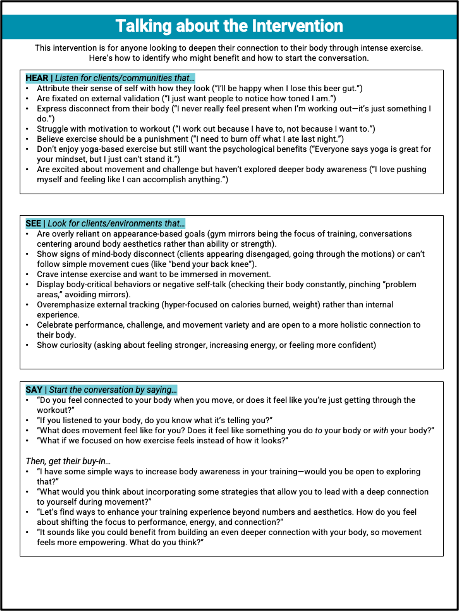

The artifact is structured for both sequential reading and ongoing reference. The first page provides an overview of the intervention, outlining its aim, expected outcomes, key reminders, and application tips. It also defines the role of the HFP, reinforcing the intervention as a flexible framework, rather than a rigid protocol, and allowing adaptation across training environments, fitness levels, and movement styles.
Subsequent sections introduce embodiment and the key dimensions this intervention aims to effect: body connection and comfort, agency and functionality, and attuned self-care. The four foundational theories that shape the framework are then defined, highlighting how social experiences influence body connection (DTE; Piran, 2017), autonomy, competence, and relatedness drive motivation (SDT; Deci & Ryan, 2000), how intensity influences affective responses (dual-mode theory; Ekkekakis, 2009), and how the brain regulates physical and emotional reactions during IE (predictive coding framework; Ainley et al., 2016).
The artifact introduces the six core constructs to foster embodiment through IE. These constructs can be mixed and matched, providing autonomy for both the HFP and the client. Each construct is presented with a defined goal, its relevance for embodied movement, coaching strategies for implementation, and a practical example (see Figure 4).
The artifact then shifts to application, guiding HFPs on integrating the intervention into training sessions. A step-by-step session example (Figure 3) demonstrates implementation across warm-up, exercise preparation, intra-session, rest, and session closure. Guidelines reinforce that principles enhance positive embodiment at all exercise intensities. A practice library provides a detailed table of specific examples and coaching strategies for each construct, organized across different training phases, to allow HFPs to reference and adapt strategies based on client goals. Suggested resources offer additional education for those who want to explore the intervention’s theoretical foundations that extend to broader fitness communities, offering strategies for cultivating inclusive, autonomy-supportive, and non-objectifying training environments.
To ensure competence, educating HFPs is a primary goal of the artifact (Standage & Ryan, 2020). Because most HFPs are not experts in embodiment research or terminology, the artifact ensures accessibility while maintaining theoretical integrity. It avoids overly academic or research-heavy terminology but does not dilute key principles.
Ensuring real-world adoption is essential to intervention success (van Zyl et al., 2019). Therefore, another goal of the intervention is to translate education into practical coaching strategies and cues, allowing HFPs to easily shift from education to practice. The construct presentation and exercise library serve as resources for implementation.
Figure 4.
Construct Presentation

Summarizing My Real-World Solution: Bridging the Gap
This intervention challenges the assumption that embodiment and IE are incompatible. The theoretical frameworks were selected for their relevance across embodiment and exercise science. SDT ensures the intervention supports intrinsic motivation, autonomy, and competence which are critical for long-term adherence (Standage & Ryan, 2020). DTE informs how social and environmental factors shape body connection and movement experience (Piran, 2017). Dual-mode theory guides how intensity influences affect, discomfort tolerance, and motivational engagement (Ekkekakis, 2009). Predictive coding framework explains how interoception and predictive modeling shape movement regulation, helping clients navigate discomfort and reframe prior negative experiences in productive ways (Marshall et al., 2018). Supplementary research synthesized six constructs that facilitate intense embodied training, enabling HFPs to influence interoception by increasing client awareness and interpretation of bodily sensations. The training emphasizes that body connection and comfort encourage positive relationships, experiences, and comfort within clients’ bodies; agency and functionality inform a coaching approach and training environment that foster agency, empowerment, voice, and joyful immersion in movement; and attuned self-care enhances embodied self-regulation through attunement to bodily, emotional, and relational needs (Piran, 2017).
This intervention bridges exercise science and embodiment research in a way that has not been systematically applied to fitness coaching. It addresses a significant gap in research by offering a paradigm shift from traditional IE approaches that emphasize aesthetics and metrics toward internally focused, embodied, and performance-driven engagement. It responds to calls for more research exploring the impact of exercise on interoception (Wallman-Jones et al., 2021).
Expected Outcomes and Long-Term Impact
HFPs and clients alike are expected to benefit from this intervention. HFPs will expand their coaching toolbox, as this intervention is designed to complement existing expertise. Clients should experience positive shifts in interoception and embodiment dimensions along with other psychological benefits of embodiment, including enhanced self-regulation and emotional regulation, positive body image, self-perception and self-concept shifts, increased intrinsic motivation in IE, and overall well-being. Additionally, the intervention allows both HFPs and clients to prioritize embodiment dimensions most applicable to their individual needs. Longitudinal analysis will be necessary to confirm these benefits and identify any additional, unanticipated outcomes, but this intervention creates that opportunity for assessment.
At the community level, widespread implementation has the potential to shift fitness culture away from objectification and aesthetic focus toward embodiment. By doing so, DTE’s intercorrelation between dimensions and domains suggests that benefits will extend beyond exercise sessions into broader aspects of client well-being (Piran et al., 2023a).
Considerations for Diverse Populations
Research indicates that individuals with heightened or diminished interoception may be sensitive to the physiological effects of IE or interoception practices (Ainley et al., 2016; Farb et al., 2015). As such, HFPs are encouraged to prompt clients with diagnosed psychological disorders to be cautious and consult their mental health professional before proceeding. The intervention process will also help in this direction because intensity is personalized using Borg’s RPE scale (1998), reinforcing autonomy in client participation and reducing the likelihood of negative well-being effects. Finally, HFPs are encouraged to discuss openly intervention benefits and considerations with all clients, regardless of their mental health history.
Discussion and Conclusion
This dissertation addresses a critical deficit in embodiment research: the over-prioritization of low-intensity, yoga-based movement that do not reflect the full spectrum of movement experiences. IE remains largely absent from embodiment discourse. Given the well-established link between embodiment and movement, the absence of embodiment-focused interventions in IE represents a significant oversight. This dissertation challenges the assumption that embodiment is exclusive to low-intensity, yoga-based movement and positions IE as a legitimate pathway for positive embodiment.
The research integrates established psychological theories with exercise science to develop an evidence-based coaching intervention that provides HFPs with tools to facilitate positive embodiment through IE. This intervention shifts coaching paradigms toward a holistic, internally attuned approach without excluding performance goals, and which applies its principles beyond low-intensity contexts, expanding accessibility and practical application.
Artifact Strengths
Performance and embodiment can coexist (Piran et al., 2023b); this intervention explicitly acknowledges and integrates both. The coaching intervention is theoretically grounded and empirically supported, merging psychological research on embodiment with exercise science for a comprehensive, interdisciplinary approach. Its scalable framework ensures adaptability across diverse training environments, expertise levels, and client goals. Real-world insights derived from my extensive professional experience ensure practical, actionable strategies, bridging theory and application effectively.
Interestingly, although designed specifically for IE, the constructs and practices are broadly applicable across exercise intensities. While cognitive reframing is particularly relevant for IE, constructs like interoception and safety hold universal relevance.
Limitations and Challenges
Despite its strengths, the intervention faces several challenges. While theoretically and empirically robust, the intervention remains untested and empirical validation is essential for practical effectiveness.
Literature review findings highlight populations where IE or interoceptive practices might be less effective or potentially harmful, including individuals with anxiety disorders, panic disorders, or unresolved trauma. These populations may misinterpret physiological responses, potentially worsening symptoms (Ainley et al., 2016; Farb et al., 2015). Recent reviews present mixed evidence regarding the relationship between exercise and anxiety reduction. Stonerock et al. (2024) reviewed 25 RCTs, noting mixed support overall and identifying only two IE-focused studies, with one demonstrating significant anxiety reduction with high-intensity interval training among incarcerated individuals (Legrand et al., 2020). Similarly, a 2018 meta-analysis reported high-intensity exercise as more effective than low-intensity for reducing anxiety and panic symptoms, though evidence was limited (Aylett et al., 2018). An overview of systematic reviews on PTSD and exercise reported consistent benefits from combined aerobic and resistance training, while yoga interventions yielded mixed results (Martinez-Calderon et al., 2024). Thus, further research is required to clarify IE’s therapeutic impact within clinical populations. Until then, HFPs without clinical training should approach IE cautiously in these contexts (Farb et al., 2015).
As noted above, gender differences, varying body compositions, and aging populations also require consideration. Research indicates affective responses to IE vary considerably based on individual experience and motivation (Dierkes et al., 2021), reinforcing the necessity of an SDT-based framework promoting voluntary participation. Clients unwilling or lacking intrinsic motivation toward IE are unlikely to experience positive benefits.
Another consideration involves less fit or inexperienced individuals, who might initially struggle with intensity. Gradual exposure, progressive overload, and cognitive reframing (Seth, 2013)—aligned with predictive coding framework —can support these individuals, yet additional empirical exploration should refine these methods and confirm effectiveness in reshaping negative prior experiences.
A notable limitation of the existing literature is the predominance of short-term outcome studies, highlighting the necessity for longitudinal research to evaluate sustained embodiment effects from IE. Additionally, practical considerations arise regarding HFP-guided versus self-directed implementation. While self-selected exercise intensity promotes autonomy (Parfitt & Hughes, 2009) and affect (Ekkekakis et al., 2020), cognitive declines during IE suggest external coaching may enhance intervention efficacy (Sudo et al., 2022) necessitating further investigation into optimal implementation strategies.
Future Research Directions
To the best of my knowledge, this is the first intervention that uniquely integrates embodiment science and IE into a coherent coaching framework. The literature review underscores the need for additional research into higher-intensity exercise within embodiment studies, echoing calls by Wallman-Jones et al. (2021). Future research should include systematic reviews or meta-analyses to clarify the long-term effects of IE on embodiment. Investigating the potential sustained benefits versus transient outcomes will further refine the intervention's scope.
Empirical testing should validate its effectiveness, refine methodologies, and clarify ethical considerations related to varying client psychological and physical needs. This involves adapting my intervention for clinical populations. While promising initial evidence supports therapeutic IE application, research must assess whether non-clinically trained HFPs can safely administer such interventions. Lastly, expanding this framework to include self-guided exercisers may significantly broaden its reach and impact.
Final Reflections
This dissertation significantly advances embodiment science by showing its importance in IE. Furthermore, my professional experience profoundly informed the artifact’s development, highlighting the transformative potential of embodied movement practices. Witnessing firsthand how interoception and positive embodiment can reshape individuals' relationships with exercise underscores the importance of accessible, practical coaching interventions.
This coaching intervention represents a significant first step in integrating IE into broader embodiment conversations. With further empirical validation and refinement, it holds the potential to significantly reshape fitness coaching practices, thereby enhancing client experiences and expanding accessibility to embodied movement across diverse populations, abilities, and settings.
References
Ainley, V., Apps, M. A. J., Fotopoulou, A., & Tsakiris, M. (2016). “Bodily precision”: A predictive coding account of individual differences in interoceptive accuracy. Philosophical Transactions of the Royal Society B: Biological Sciences, 371(1708). https://doi.org/10.1098/rstb.2016.0003
Alleva, J. M., Tylka, T. L., van Oorsouw, K., Montanaro, E., Perey, I., Bolle, C., Boselie, J., Peters, M., & Webb, J. B. (2020). The effects of yoga on functionality appreciation and additional facets of positive body image. Body Image, 34, 184-195. https://doi.org/10.1016/j.bodyim.2020.06.003
Aylett, E., Small, N., & Bower, P. (2018). Exercise in the treatment of clinical anxiety in general practice - a systematic review and meta-analysis. BMC Health Services Research, 18(1), 559. https://doi.org/10.1186/s12913-018-3313-5
Bandura, A. (1997). Self-efficacy: The exercise of control. W.H. Freeman.
Borg, G. A. (1998). Borg’s Perceived Exertion and Pain Scales. Human Kinetics.
Boyatzis, R. E. (2006). An overview of intentional change from a complexity perspective. The Journal of Management Development, 25, 607–623. 10.1108/02621710610678445
Calogero, R. M., Tylka, T. L., McGilley, B. H., & Pedrotty-Stump, K. N. (2019). Attunement with Exercise (AWE). In T. L. Tylka (Ed.) Handbook of positive body image and embodiment (pp. 80-C8.P62). Oxford Academic. https://doi.org/10.1093/med-psych/9780190841874.003.0009
Carey, M., Crucianelli, L., Preston, C., & Fotopoulou, A. (2019). The effect of visual capture towards subjective embodiment within the full body illusion. Scientific Reports, 9(1), 2889. https://doi.org/10.1038/s41598-019-39168-4
Ciarrochi, J., Hayes, S. C., Oades, L. G., & Hofmann, S. G. (2022). Toward a unified framework for positive psychology interventions: Evidence-based processes of change in coaching, prevention, and training. Frontiers in Psychology, 12. https://doi.org/10.3389/fpsyg.2021.809362
Clark, A. (2018). Exploring women’s embodied experiences of ‘the gaze’ in a mix-gendered UK gym. Societies, 8(1), 2. https://doi.org/10.3390/soc8010002
Critical Appraisal Skills Programme (2024). CASP randomised controlled trial checklist. [online] Available at: https://casp-uk.net/casp-tools-checklists/randomised-controlled-trial-rct-checklist/. Accessed: 11-January-2025
Critical Appraisal Skills Programme (2024). CASP systematic reviews with meta-analysis of randomised controlled trials (RCTs). [online] Available at: https://casp-uk.net/casp-tools-checklists/systematic-reviews-meta-analysis-rcts/. Accessed: 11-January-2025
Daubenmier, J. J. (2005). The relationship of yoga, body awareness, and body responsiveness to self-objectification and disordered eating. Psychology of Women Quarterly, 29(2), 207-219. https://doi.org/10.1111/j.1471-6402.2005.00183.x
Deci, E. L., & Ryan, R. M. (2000). The "what" and "why" of goal pursuits: Human needs and the self-determination of behavior. Psychological Inquiry, 11(4), 227-268. https://doi.org/10.1207/S15327965PLI1104_01
Dierkes, K., Mattioni Maturana, F., Rösel, I., Martus, P., Nieß, A. M., Thiel, A., & Sudeck, G. (2021). Different endurance exercise modalities, different affective response: A within-subject study. Frontiers in Psychology, 12. https://doi.org/10.3389/fpsyg.2021.686661
Dregney, T. M., Thul, C. M., Linde, J. A., & Lewis, B. A. (2023). Affective responses to high intensity interval training relative to moderate intensity continuous training. Physical Activity and Health, 7(1), 229-238. https://doi.org/10.5334/paah.271
Ekkekakis, P. (2009). The dual-mode theory of affective responses to exercise in metatheoretical context: II. bodiless heads, ethereal cognitive schemata, and other improbable dualistic creatures, exercising. International Review of Sport and Exercise Psychology, 2(2), 139-160. https://doi.org/10.1080/17509840902829323
Ekkekakis, P., Hartman, M. E., & Ladwig, M. A. (2020). Affective responses to exercise. In G. Tenenbaum, & R. C. Eklund (Eds.), Handbook of sport psychology (pp. 233-253). John Wiley & Sons.
Farb, N., Daubenmier, J., Price, C. J., Gard, T., Kerr, C., Dunn, B. D., Klein, A. C., Paulus, M. P., & Mehling, W. E. (2015). Interoception, contemplative practice, and health. Frontiers in Psychology, 6(JUN). https://doi.org/10.3389/fpsyg.2015.00763
Garnsey, C. L., Gnall, K. E., Osherow, E. K., & Park, C. L. (2025). Changes in body awareness in yoga interventions: A systematic review. Complementary Therapies in Clinical Practice, 59(101977). https://doi.org/10.1016/j.ctcp.2025.101977
Gattario, K. H., Frisén, A., Teall, T. L., & Piran, N. (2020). Embodiment: Cultural and gender differences and associations with life satisfaction. Body Image, 35, 1-10. https://doi.org/10.1016/j.bodyim.2020.07.005
Grabauskaitė, A., Baranauskas, M., & Griškova-Bulanova, I. (2017). Interoception and gender: What aspects should we pay attention to? Consciousness and Cognition, 48, 129-137. https://doi.org/10.1016/j.concog.2016.11.002
Günebakan, Ö., & Acar, M. (2023). The effect of tele-yoga training in healthy women on menstrual symptoms, quality of life, anxiety-depression level, body awareness, and self-esteem during COVID-19 pandemic. Irish Journal of Medical Science, 192(1), 467-479. https://doi.org/10.1007/s11845-022-02985-0
Halliwell, E. (2013). The impact of thin idealized media images on body satisfaction: Does body appreciation protect women from negative effects? Body Image, 10(4), 509-514. https://doi.org/10.1016/j.bodyim.2013.07.004
Herbert, B. M., & Pollatos, O. (2012). The body in the mind: On the relationship between interoception and embodiment. Topics in Cognitive Science, 4(4), 692-704. https://doi.org/10.1111/j.1756-8765.2012.01189.x
Herbert, B. M., Ulbrich, P., & Schandry, R. (2007). Interoceptive sensitivity and physical effort: Implications for the self-control of physical load in everyday life. Psychophysiology, 44(2), 194-202. https://doi.org/10.1111/j.1469-8986.2007.00493.x
Hutchinson, J. C. (2021). Perceived effort and exertion. In Z. Zenko & L. Jones (Eds.), Essentials of exercise and sport psychology: An open access textbook (pp. 294–315). Society for Transparency, Openness, and Replication in Kinesiology. https://doi.org/10.51224/B1013
Jankauskiene, R., Balciuniene, V., Rutkauskaite, R., Pajaujiene, S., & Baceviciene, M. (2024). The effects of Nirvana fitness and functional training on the body appreciation of young women: Non-randomized controlled trial. Frontiers in Psychology, 15. https://doi.org/10.3389/fpsyg.2024.1412259
La Forge, R. (2014). Mind-body exercise. In C. X. Bryant, S. Jo, & D. J. Green (Eds.), ACE personal trainer manual (5th ed., pp. 480-509). American Council on Exercise.
LaGuardia-LoBianco, A., & Bloomfield, P. (2023). The axiology of pain and pleasure. Journal of Value Inquiry. https://doi.org/10.1007/s10790-023-09941-w
Leech, K., Stapleton, P., & Patching, A. (2024). A roadmap to understanding interoceptive awareness and post-traumatic stress disorder: A scoping review. Frontiers in Psychiatry, 15, 1355442. https://doi.org/10.3389/fpsyt.2024.1355442
Limmeroth, J., Schücker, L., & Hagemann, N. (2022). Don’t stop focusing when it gets harder! The positive effects of focused attention on affective experience at high intensities. Journal of Sports Sciences, 40(18), 2018-2027. https://doi.org/10.1080/02640414.2022.2127511
Lundh, L. G., & Foster, L. (2024). Embodiment as a synthesis of having a body and being a body, and its role in self-identity and mental health. New Ideas in Psychology, 74, 101083. https://doi.org/10.1016/J.NEWIDEAPSYCH.2024.101083
Maddux, J.E. (2002) Self-efficacy: The power of believing you can. In C.R. Snyder and S.J. Lopez (Eds.), Handbook of positive psychology (pp. 277-287). Oxford University Press.
Mahlo, L., & Tiggemann, M. (2016). Yoga and positive body image: A test of the embodiment model. Body Image, 18, 135-142. https://doi.org/10.1016/j.bodyim.2016.06.008
Maister, L., Hodossy, L., & Tsakiris, M. (2017). You fill my heart: Looking at one’s partner increases interoceptive accuracy. Psychology of Consciousness: Theory Research, and Practice, 4(2), 248-257. https://doi.org/10.1037/cns0000110
Marshall, A. C., Gentsch, A., & Schütz-Bosbach, S. (2018). The interaction between interoceptive and action states within a framework of predictive coding. Frontiers in Psychology, 9(FEB). https://doi.org/10.3389/fpsyg.2018.00180
Martinez-Calderon, J., Villar-Alises, O., García-Muñoz, C., Pineda-Escobar, S., & Matias-Soto, J. (2024). Multimodal exercise programs may improve posttraumatic stress disorders symptoms and quality of life in adults with PTSD: An overview of systematic reviews with meta-analysis. Clinical Rehabilitation, 38(5), 573–588. https://doi.org/10.1177/02692155231225466
Matei, D., Trofin, D., Iordan, D. A., Onu, I., Condurache, I., Ionite, C., & Buculei, I. (2023). The endocannabinoid system and physical exercise. International Journal of Molecular Sciences, 24(3), 1989. https://doi.org/10.3390/ijms24031989
Mehling, W. E., Price, C., Daubenmier, J. J., Acree, M., Bartmess, E., & Stewart, A. (2012). The multidimensional assessment of interoceptive awareness (MAIA). PLoS ONE, 7(11), e48230. https://doi.org/10.1371/journal.pone.0048230
Menzel, J. E., & Levine, M. P. (2010). Embodying experiences and the promotion of positive body image: The example of competitive athletics. In R. M. Calogero, S. Tantleff-Dunn, & J. K. Thompson (Eds.), Self-objectification in women: Causes, consequences, and counteractions (pp. 163-186). https://doi.org/10.1037/12304-008
Moffatt, J., Finotti, G., & Tsakiris, M. (2024). With hand on heart: A cardiac rubber hand illusion. Biological Psychology, 186, 108756. https://doi.org/10.1016/j.biopsycho.2024.108756
Monti, A., Porciello, G., Tieri, G., & Aglioti, S. M. (2020). The “embreathment” illusion highlights the role of breathing in corporeal awareness. Journal of Neurophysiology, 123(1), 420-427. https://doi.org/10.1152/JN.00617.2019
Mulder, J., Boelens, M., van der Velde, L. A., Brust, M., & Kiefte-de Jong, J. C. (2025). The role of interoception in lifestyle factors: A systematic review. Neuroscience & Biobehavioral Reviews, 169, 106018. https://doi.org/10.1016/J.NEUBIOREV.2025.106018
Neumark-Sztainer, D., Watts, A. W., & Rydell, S. (2018). Yoga and body image: How do young adults practicing yoga describe its impact on their body image? Body image, 27, 156-168. https://doi.org/10.1016/j.bodyim.2018.09.001
Ntoumanis, N., Ng, J. Y. Y., Prestwich, A., Quested, E., Hancox, J. E., Thøgersen-Ntoumani, C., Deci, E. L., Ryan, R. M., Lonsdale, C., & Williams, G. C. (2021). A meta-analysis of self-determination theory-informed intervention studies in the health domain: effects on motivation, health behavior, physical, and psychological health. Health Psychology Review, 15(2), 214-244. https://doi.org/10.1080/17437199.2020.1718529
Page, M. J., McKenzie, J. E., Bossuyt, P. M., Boutron, I., Hoffmann, T. C., Mulrow, C. D., ... & Moher, D. (2021). The PRISMA 2020 statement: An updated guideline for reporting systematic reviews. bmj, 372.
Parfitt, G. & Hughes, S. (2009). The exercise intensity–affect relationship: Evidence and implications for exercise behavior. Journal of Exercise Science and Fitness, (7)2, S34-S41. https://doi.org/10.1016/S1728-869X(09)60021-6
Pfeifer, G., & Cawkwell, S. (2025). Interoceptive ageing and the impact on psychophysiological processes: A systematic review. International Journal of Psychophysiology, 207, 112483. https://doi.org/10.1016/J.IJPSYCHO.2024.112483
Piran, N. (2017). The developmental theory of embodiment: Discovering paths in the body journeys of girls and women. In N. Piran (Ed.), Journeys of embodiment at the intersection of body and culture (pp.1-42). Academic Press. https://doi.org/10.1016/B978-0-12-805410-9.00001-3
Piran, N., Counsell, A., Teall, T. L., Komes, J., & Evans, E. H. (2023a). The developmental theory of embodiment: Quantitative measurement of facilitative and adverse experiences in the social environment. Body Image, 44, 227-245. https://doi.org/10.1016/j.bodyim.2022.12.005
Piran, N., & Neumark-Sztainer, D. (2020). Yoga and the experience of embodiment: a discussion of possible links. Eating Disorders, 28(4), 330-348. https://doi.org/10.1080/10640266.2019.1701350
Piran, N., Teall, T. L., & Counsell, A. (2023b). The experience of embodiment scale: Development and psychometric evaluation. Body Image, 34, 117-134. https://doi.org/10.1016/j.bodyim.2020.05.007
Piran, N., Teall, T. L., & Counsell, A. (2023c). Expanding the social lens: A quantitative study of the developmental theory of embodiment. Body Image, 44, 246–261. https://doi.org/10.1016/J.BODYIM.2022.11.009
Porcari, J. P. & Foster, C. (2010). Exercise physiology. In C. X. Bryant & D. J. Green (Eds.), Essentials of exercise science for fitness professionals (pp. 67-92). American Council on Exercise.
Rao, R., & Ballard, D. (1999). Predictive coding in the visual cortex: a functional interpretation of some extra-classical receptive-field effects. Nature Neuroscience, 2, 79-87. https://doi.org/10.1038/4580
Robinson, E., Foote, G., Smith, J., Higgs, S., & Jones, A. (2021). Interoception and obesity: a systematic review and meta-analysis of the relationship between interoception and BMI. In International Journal of Obesity, 45(12), 2515–2526. https://doi.org/10.1038/s41366-021-00950-y
Ryan, R. M., Patrick, H., Deci, E. L., & Williams, G. C. (2008). Facilitating health behaviour change and its maintenance: Interventions based on Self-Determination Theory. The European Health Psychologist, 10, 2-5.
Salvato, G., Richter, F., Sedeño, L., Bottini, G., & Paulesu, E. (2020). Building the bodily self-awareness: Evidence for the convergence between interoceptive and exteroceptive information in a multilevel kernel density analysis study. Human Brain Mapping, 41(2), 401-418. https://doi.org/10.1002/hbm.24810
SantaBarbara, N. J., Whitworth, J. W., & Ciccolo, J. T. (2017). A systematic review of the effects of resistance training on body image. Journal of Strength and Conditioning Research, 31(10), 2880-2888. https://doi.org/10.1519/JSC.0000000000002135
Schneider, J., Malinowski, P., Watson, P. M., & Lattimore, P. (2019). The role of mindfulness in physical activity: A systematic review. Obesity Reviews, 20(3), 448-463. https://doi.org/10.1111/obr.12795
Seth, A. K. (2013). Interoceptive inference, emotion, and the embodied self. Trends in Cognitive Sciences, 17(11), 565-573. https://doi.org/10.1016/j.tics.2013.09.007
Silvanto, J., & Nagai, Y. (2025). How Interoception and the Insula Shape Mental Imagery and Aphantasia. Brain Topography, 38(27). https://doi.org/10.1007/s10548-025-01101-6
Spence, G. B. & Oades, L., G. (2011). Coaching with self-determination in mind: Using theory to advance evidence-based coaching practice. International Journal of Evidence Based Coaching and Mentoring, 9(2), 37–55.
Standage, M., & Ryan, R. M. (2020). Self‐determination theory in sport and exercise. In G. Tenenbaum, & R. C. Eklund (Eds.), Handbook of sport psychology (pp. 37-56). John Wiley & Sons.
Stanley, D. M., & Cumming, J. (2010). Are we having fun yet? Testing the effects of imagery use on the affective and enjoyment responses to acute moderate exercise. Psychology of Sport and Exercise, 11(6) 582-590. https://doi.org/10.1016/j.psychsport.2010.06.010
Sudo, M., Costello, J. T., McMorris, T., & Ando, S. (2022). The effects of acute high-intensity aerobic exercise on cognitive performance: A structured narrative review. Frontiers in Behavioral Neuroscience, 16. https://doi.org/10.3389/fnbeh.2022.957677
Teixeira, P. J., Carraça, E. V., Markland, D., Silva, M. N., & Ryan, R. M. (2012). Exercise, physical activity, and self-determination theory: A systematic review. International Journal of Behavioral Nutrition and Physical Activity, 9(78). https://doi.org/10.1186/1479-5868-9-78
Treves, I. N., Tello, L. Y., Davidson, R. J., & Goldberg, S. B. (2019). The relationship between mindfulness and objective measures of body awareness: A meta-analysis. Scientific Reports, 9(1), 17386. https://doi.org/10.1038/s41598-019-53978-6
Tylka, T. L., & Wood-Barcalow, N. L. (2015). The Body Appreciation Scale-2: Item refinement and psychometric evaluation. Body Image, 12(1), 53-67. https://doi.org/10.1016/J.BODYIM.2014.09.006
van Zyl, L. Efendić, E, Rothmann, S. & Shankland, R. (2019). Best-practice guidelines for positive psychological intervention research design. In: L. Van Zyl & S. Rothmann (Eds), Positive psychological intervention design and protocols for multi-cultural contexts (pp. 1-32). Springer. https://doi.org/10.1007/978-3-030-20020-6_1
Wallman-Jones, A., Nigg, C., Benzing, V., & Schmidt, M. (2023). Leave the screen: The influence of everyday behaviors on self-reported interoception. Biological Psychology, 181, 108600. https://doi.org/10.1016/j.biopsycho.2023.108600
Wallman-Jones, A., Perakakis, P., Tsakiris, M., & Schmidt, M. (2021). Physical activity and interoceptive processing: Theoretical considerations for future research. In International Journal of Psychophysiology, 166, 38-49. https://doi.org/10.1016/j.ijpsycho.2021.05.002
Wang, H., Callaghan, E., Gooding-Williams, G., McAllister, C., & Kessler, K. (2016). Rhythm makes the world go round: An MEG-TMS study on the role of right TPJ theta oscillations in embodied perspective taking. Cortex, 75, 68-81. https://doi.org/10.1016/j.cortex.2015.11.011
Webb, J. B., Vinoski, E. R., Warren-Findlow, J., Padro, M. P., Burris, E. N., & Suddreth, E. M. (2017). Is the “Yoga Bod” the new skinny? A comparative content analysis of mainstream yoga lifestyle magazine covers. Body Image, 20, 87-98. https://doi.org/10.1016/j.bodyim.2016.11.005
Wittkopf, P. G., Lloyd, D. M., & Johnson, M. I. (2017). Changing the size of a mirror-reflected hand moderates the experience of embodiment but not proprioceptive drift: a repeated measures study on healthy human participants. Experimental Brain Research, 235(6), 1933-1944. https://doi.org/10.1007/s00221-017-4930-7


Comments